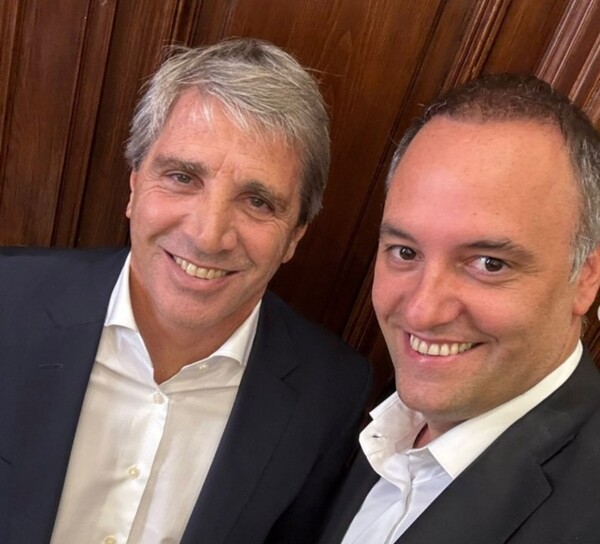
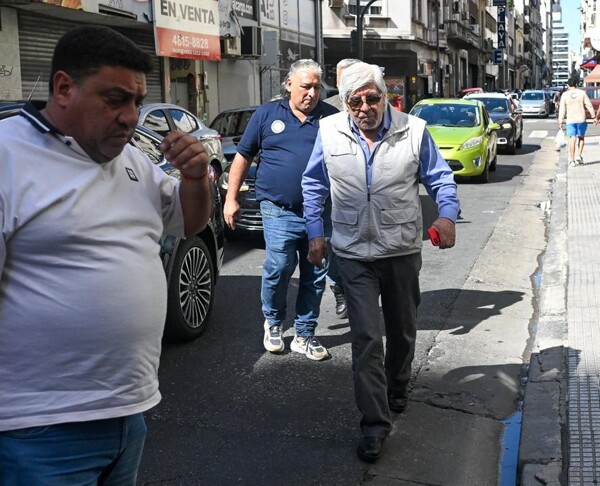
Buenos Aires, February 25, 2026 - Ornella Calvete, a former official of the Ministry of Economy, filed an appeal to try to reverse the processing ordered by Federal Judge Sebastián Casanello in the investigation for alleged bid-rigging and overpricing in purchases of the National Disability Agency (ANDIS). According to her version, Miguel Ángel Calvete offered her a studio in a building on Mexico 55. On this point, she stated that the contracts were made through the FAMP (Fund for the Expansion of the Fuegian Productive Matrix) and that she had no influence on that circuit. Regarding a commercial project linked to the import of urea from Kazakhstan, she stated that it was a private initiative intended for a later state stage and that she asked for her father's help for business experience, not for his public role. The file adds an additional seasoning: Miguel Ángel Calvete has previous judicial records, and according to public records, he was convicted in a case for the economic exploitation of third-party prostitution. In the specific case of Ornella Calvete, Casanello prosecuted her for the crimes of illicit association, fraud, incompatible negotiations, and failure to duties of a public official. That data now appears as a backdrop for a defense that seeks to separate, with a scalpel, the father's assets and movements from the daughter's responsibilities. With the appeal already filed, the case enters a decisive stage: the courts must evaluate whether the explanation about the origin of the money and Ornella Calvete's role is enough to weaken the accusation or, on the contrary, the accumulated evidence supports the alleged plot. At the center of her defense appears the point that generated the most public impact since the case broke: the nearly US$ 700,000 found in her apartment during a raid. Calvete assures that that money “was already there” when she moved in, that in its largest part it belonged to her father, Miguel Ángel Calvete, and that she never administered or disposed of that cash. The raid, carried out as part of the investigation, ended with the seizure of bundles of bills for US$ 695,457, $19,996,200 and 1,960 euros, in addition to documentation and devices. There, always according to the appeal, her father warned her before the move that he had left cash locked in a drawer, as well as other personal objects, due to a “complicated prior judicial situation.” In turn, she maintains that another part belonged to Cardini and that a third fraction was indeed hers, but through a channel she claims is legal: a donation from her father made by public deed. In the appeal, she also tries to use to her advantage an exchange of messages from November in which she warns her father about the presence of police in the building and asks if INDECOMM SRL had “white cash.” She would have responded that he should not worry, that they would not touch anything. In that context, the former official adds that a significant portion of the cash (she mentions US$ 600,000) was claimed by a shareholder linked to INDECOMM SRL, a company constituted by her father. In her writing, the former official states that she was unaware of the exact amount and origin of the money, and that its discovery surprised her at the moment of the operation. Her defense seeks to install a simple idea: the money was not part of her daily life or her decisions, and therefore, it cannot be used as automatic proof of enrichment linked to the case. The explanation is based on the “route” of how she came to live there. Calvete relates that, in March 2025, due to the discomfort of traveling every day from Escobar to the microcenter, she asked her father for a place to move near her work. In the middle, there is an outrageous postcard: resources intended for people with disabilities under suspicion of having been used as a business cash box, while the file advances with prosecutions that promise a long and rough judicial journey. Sources consulted: La Nación; Infobae; Página/12; El País; Ministerio Público Fiscal; El Día. “I had no commercial relationship with the involved parties nor intervention in ANDIS contracts,” stated her lawyer, Fernando Manzanares. Furthermore, the former official sought to distance herself from Profarma, a pharmacy mentioned as a beneficiary in the maneuver and formally linked to Ruth Noemí Lozano. Her argument: if she had managed that money, she would have moved or hidden it after that “false alarm”; but the cash remained in the same place and was found a month later in the raid. The ANDIS case was activated after the dissemination of audios attributed to the former director of the agency, Diego Spagnuolo, in which a supposed bribery scheme is mentioned. A few months later, when she decided to live with her partner, Javier Cardini—also displaced after the scandal—she moved to a larger apartment in the same building, also offered by her father. She also rejected the accusation of having used her position to favor the private interests of her father, including supposed insider information and hiring of people close to her—such as Lozano and Patricia Canavesio. At the beginning of this month, a batch of 19 prosecutions advanced, which reached, among others, Spagnuolo, the doctor Pablo Atchabahian, Miguel Ángel Calvete and Ornella Calvete, to whom they attribute a role within the alleged gear. The hypothesis that Federal Justice investigates points to a distortion of the mechanism for purchasing high-cost benefits—with a focus on the PACBI program—through the targeted selection of bidders and overpricing, based on coordination between officials and private actors. Although the origin of those recordings is still the subject of discussion and the defense of several defendants questions its validity, Judge Casanello and Prosecutor Franco Picard maintain that the file “has a life of its own” due to the evidence gathered.

Ex-Official Ornella Calvete Appeals Corruption Charges
Ornella Calvete, a former Ministry of Economy official, is appealing her indictment in a corruption scandal investigation at the National Disability Agency (ANDIS). She claims the nearly $700,000 found in her apartment belonged to her father and was unrelated to her official duties. Her defense seeks to separate her actions from her father's, who is also a defendant in the case.